
Many years ago, I was listening to a VC speak on a panel about how they made investment decisions.
At some point in this talk, he made a point that contradicted one of my core assumptions about the industry:
“An important consideration is how fundable an idea is; whether other firms also agree it’s a good prospect.”
The other figures on stage nodded sagely. Yes, an important consideration.
How naive I had been, believing that VCs were daring contrarians, and it turns out they’re all riddled with the need for peer-validation?
Certainly, this wasn’t the attitude of venture capital’s forefathers. When did that change?
No Consequences
This shift toward structural consensus-seeking is a consequence of unabated scaling in a fundamentally unscalable strategy. Cycles of boom and bust have failed to correct this ambition, as they’ve had a heavily asymmetrical impact.
Indeed, as the industry has evolved (and the goalposts have moved) the incumbents of venture capital have become free to fail without having to face the cost of failure.
After the dotcom bubble burst, capital pulled back to the “safe haven” of San Francisco and consolidated in the incumbents that inflated it to begin with. The same has happened in every cycle since, most recently in 2022.
These cycles have decimated peripheral regional hubs that were home to vital industrial tech, like Austin’s “Silicon Hills”. They have also been particularly hard on smaller venture capital firms that lack track record and entrenched LP relationships.
So, while the giants of San Francisco’s venture capital scene may briefly decline in an absolute sense, they have continued to accelerate growth on a relative basis.
There can be no switch it off and on again to restore the health of venture capital, in this context. Instead, there is the cyclical culling of insurgent firms and new ideas. Often just as they begin to look threatening to incumbents.
“Venture capital firms, old and new, will continue to play a critical role in the innovation ecosystem by funding promising business ideas. These early signs of disruptions suggest challenger VCs will be formidable competitors in the future.1
The Future of Venture Capital (2021)
If you remove the consequences for failure, and reward raw accumulation with stability, you invite the formation of hierarchies and rent-seeking behavior. The potential for performance slowly falls in line with whatever best serves incumbent interests.
Venture capital’s bifurcation has been portrayed as “the inevitable death of the center” seen in other maturing asset classes as they diverge into ‘boutique specialists’ and ‘large generalists’.
However, this is not an accurate description of what has happened in venture capital or how the market is structured.
“Venture capital as currently constituted does not follow ‘venture logic’ in any real sense, and comparing it to other asset classes without explaining the particular points of similarity between them is laundering the reputations and structural stability of those other assets.”
Del Johnson
In no other strategy are the “boutique” firms so hopelessly dependent on the activity of “large” firms.
- Large firms may “anoint” a company with capital and signal, herding-in other investors, or they might be vocal about passing. Either may make-or-break a small firm.
- Even if they do choose to invest in a company, they retain the ability to crush earlier “boutique” investors with dilution or reward them with continued syndication.
Large firms also have a wildly underestimated role in the capitalisation of new entrants.
- Through their LP activity, they influence which managers are able to raise funds, and therefore which strategies and theses may be tested in the market.
- From the firms they invest in, they’re able to collect data on the underlying portfolio companies which may have strategic value for their own investments.
Indeed, I recently conducted a survey of smaller venture capital firms on the makeup of their LP base. For funds raised prior to the crash in 2022, a staggering 93% had a large firm as an LP. This fell to (a still surprisingly high) 68% for funds raised since.
These stats raise a number of questions. To a cynic, it might appear as though large firms enabled the dependence of new entrants and then rug-pulled them when the market collapsed.
Certainly, this relationship doesn’t reflect the nature of the “barbell distribution” in mature asset classes — and is perhaps more “pyramid” in shape.
Hyper-fragility
The concept of “fundability” arose in response to the inflation of funding rounds with software’s appetite for growth capital (particularly in periods with low interest-rates). Thus, the ability to build large, well capitalised syndicates around a company became a core part of the venture capital playbook.
Thanks to venture capital’s inclination toward “concentration without consequences”, the firms who were most influential in the coordination of these syndicates have been the most likely to survive across cycles.
Their ability to manifest a “synthetic consensus” (creating a localised area of low-cost capital) is now responsible for the majority of allocation into and out of venture capital — despite all of the obvious wisdom that contradicts signal-based investing.
This leaves the rest of the venture capital market with an unpleasant choice:
- Go with the flow of this commensal relationship for the sake of survival. Deliver for incumbents by executing their thesis, surfing in the wake of their momentum, even if it means weaker ultimate performance for your fund.
- Operate as an independent, knowing that raising funds will be harder, securing follow-on capital for portfolio companies will be a battle, the paper growth of your investments will be slower, and if the market tightens up you’re highly likely to be put out of business.
Increasingly, and unsurprisingly after three brutal years for fundraising, more are picking the former. They’ll “play the game on the field”, serving incumbents by herding into consensus like lemmings to support the anointed winners.
Thus, smaller managers are abandoning the hunt for Alpha, and instead pursue this mediocre strategy of “Beta to the Center”.2
The outcome is growing concentration and the continued erosion of returns across the whole venture capital strategy, particularly for small managers.
The one edge that small managers once offered over larger incumbents, the promise of outperformance, is also slowly being chipped away.
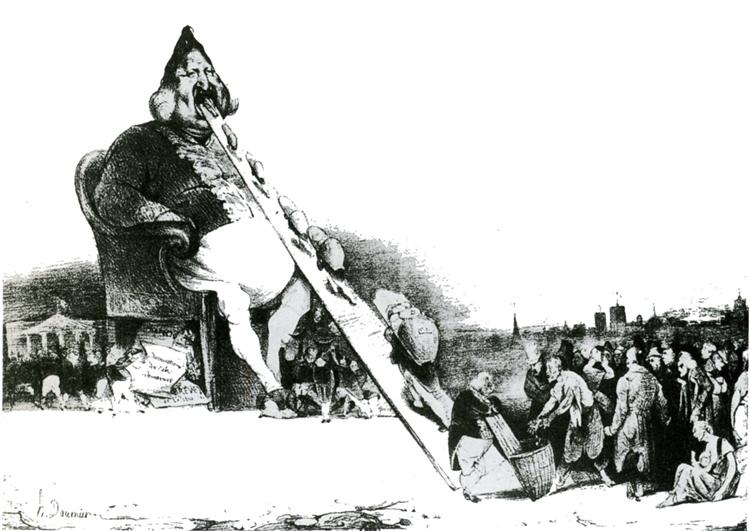
(top image: “Gargantua”, by Honoré Daumier)
- Narrator: They were mostly wiped out. [↩]
- An obvious reference to There Is No Economy but Only the Debt to the Center [↩]
Leave a Reply