All value created by venture capital, in any vintage and every category, is downstream of the industry’s ability to recognise brilliant individuals and ideas.
It is an investment strategy built on discovery. Large pools of institutional capital are diffused through thousands of individual firms, providing broad coverage across industries, geographies and technologies. The failures mostly flare out as cheap experiments, while a handful of outliers produce extreme value.
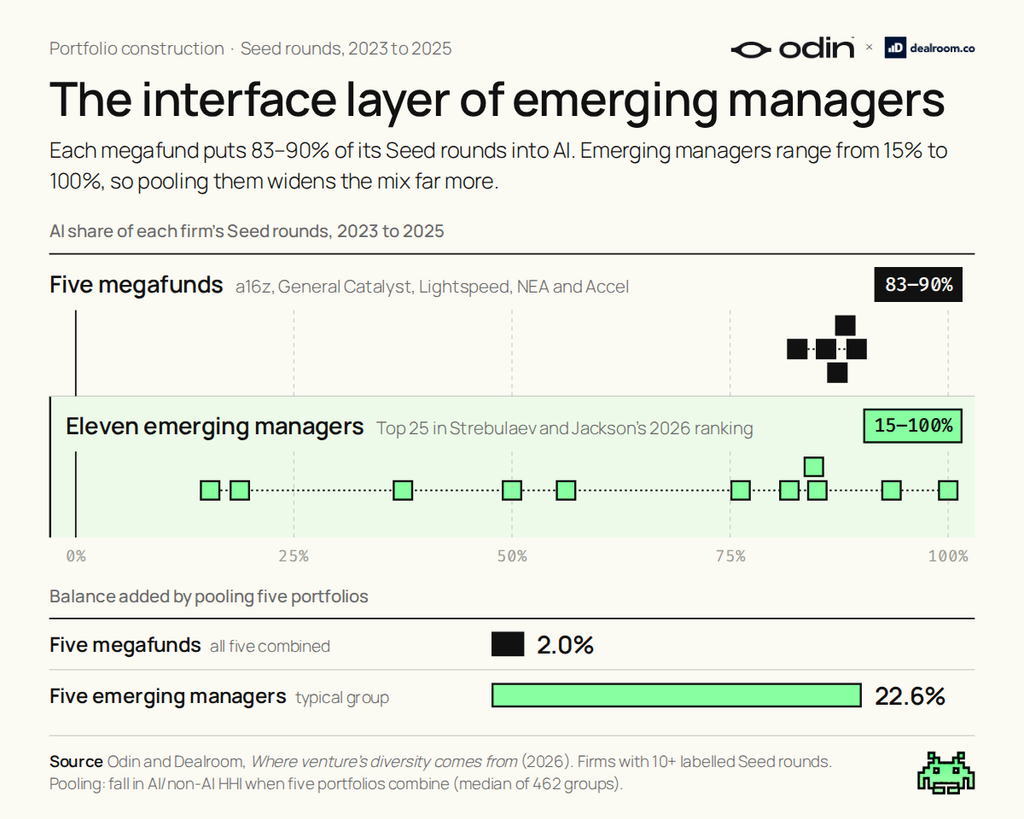
Implicit in this arrangement is venture capital’s need for a healthy market of small firms and emerging managers. Individuals who bring a unique perspective to deployment, with differentiated sourcing and varying models of the world.
This is the ragged edge of the venture market, maximising the surface area of opportunity.
Over the past 15 years, venture capital has been augmented with a second pool of capital, as much larger LPs entered the strategy when rates were low.
This flood of capital spawned the “money for winners” megafunds, whose strategy is to double-down on the obviously attractive companies.
The scale of megafunds has contributed to companies staying private longer, pulling more capital into private markets. At the same time, their LP base is less sensitive to liquidity, able to tap other assets like treasury bills, money-market funds or index holdings for near-term cash needs.
Indeed, if you divide the market into funds below $1B as a proxy for “money for experiments”, and funds above $1B as a proxy for “money for winners”, only the latter has really grown. The same is true for rounds above $100M, now clearly the majority of the market — having been closer to a quarter of total volume a decade ago.
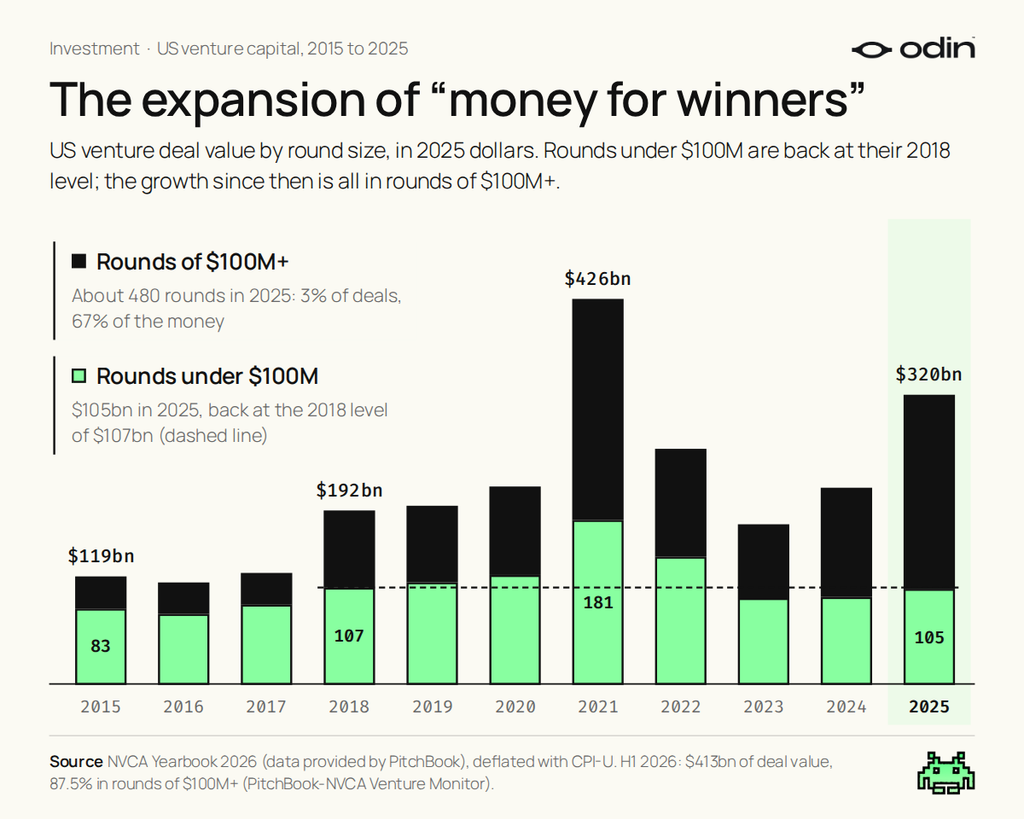
This increasing top-heaviness is the result of a recursive function where smaller LPs rely on regular liquidity to recycle into new commitments while the larger LPs just want to hold for steady IRR growth — so weak exit markets become a ratchet on fund size.
i.e. Small firms started to wash out of the market due to poor liquidity ➔ the venture landscape became narrower ➔ concentration accelerated IRR growth as more capital funneled into fewer companies ➔ megafunds metrics appeared healthy ➔ the top end of the market expands ➔ liquidity weakens further… And on it goes.
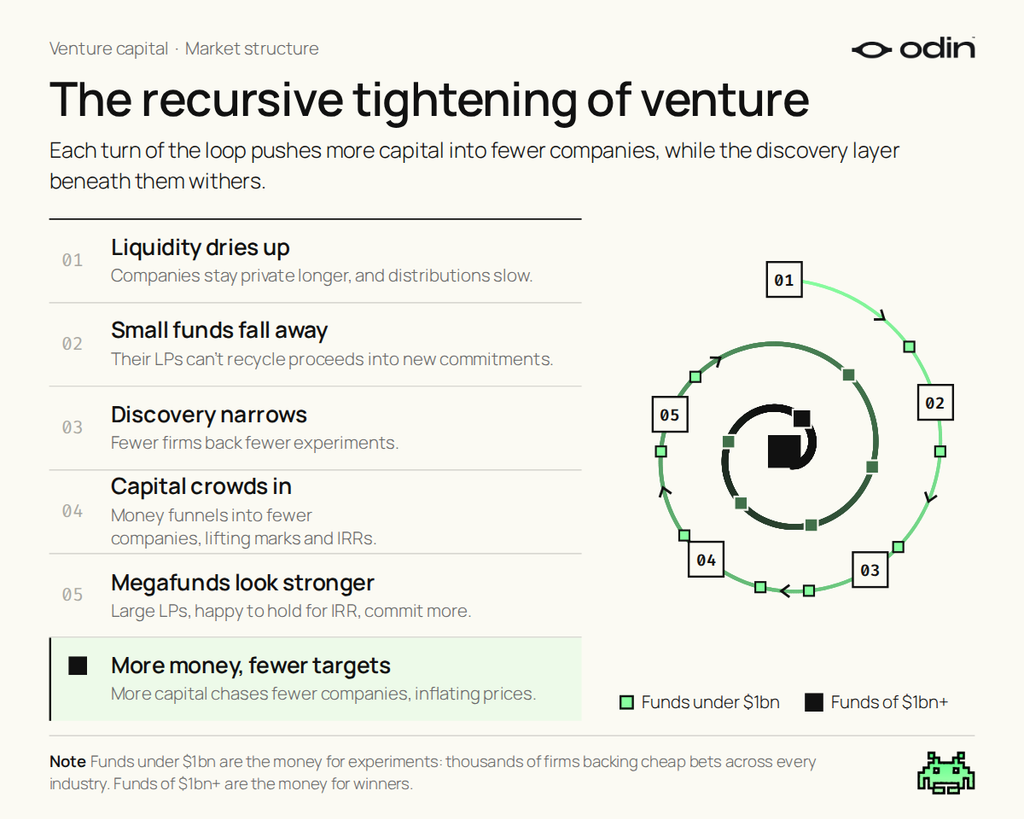
As a result, the venture market is now awash with “money for winners”, while the discovery layer actually responsible for finding those winners has withered.
There is more money than ever for a shrinking number of targets, with much less intellectual bandwidth to ensure it is allocated with care and diligence. This has resulted in inflated prices, herd behavior, and a market that feels increasingly unhinged — with companies like Instinct raising $1B at a $10B valuation, pre-revenue and sans-moat.
Essentially, if there is no real pressure to regularly reconcile your marks with reality through an exit, you can keep marking your own book as long as you like. Eventually, and inevitably, that spirals until all contact with reality is lost.
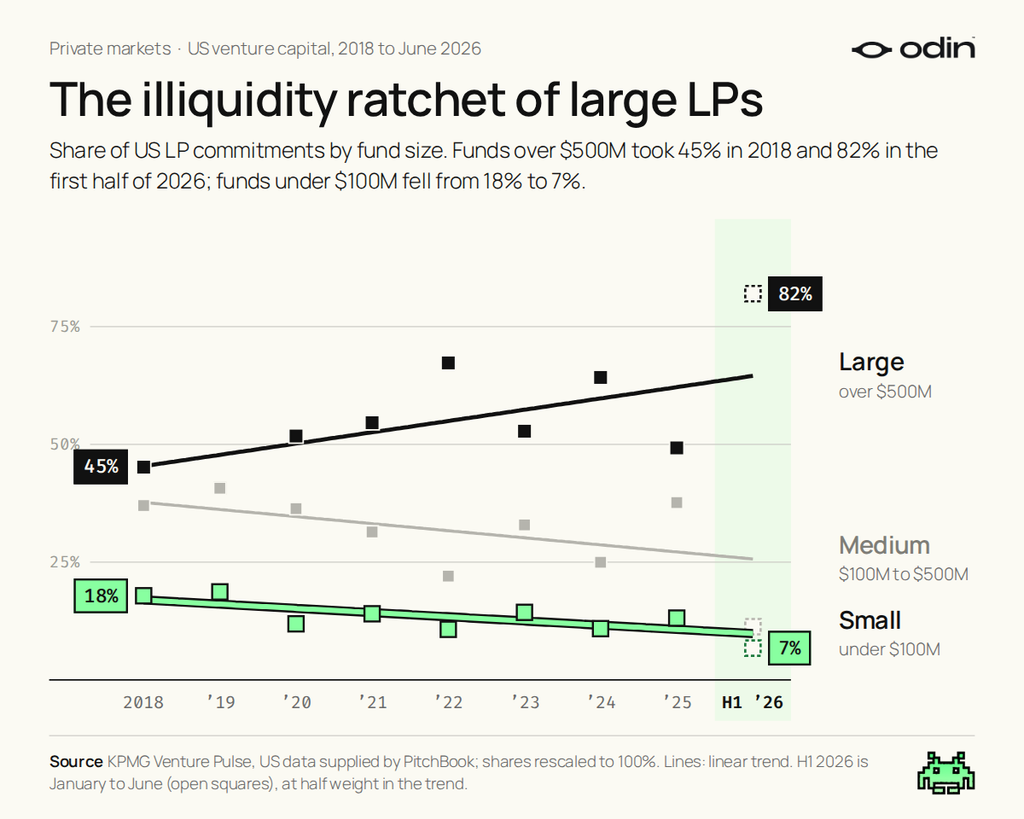
Up to now, the megafund concept has been justified by the need for large LPs to make large individual commitments, where many smaller commitments would create a burden of admin and management. However, their divergent priorities (lower hurdle for performance, effectively no real need for liquidity) have created an imbalance in the market, and whatever metrics they do generate are increasingly divorced from reality.
There is a simple and well-established remedy to this: the fund of funds.
“Venture FoFs offer a streamlined alternative, often providing better access, superior diversification, and historically strong net performance, despite the additional fees. They also provide the benefits of operational efficiencies, downside protection, and vintage year diversification.”
John Felix, Pattern Ventures
Traditionally this intermediary structure has been looked down on for adding another layer of fees between the LP and the GPs. However, there’s a growing body of evidence that FoFs offer slight outperformance, net of fees, by applying a specialist focus to the otherwise intensive challenge of sourcing and picking managers — a process which few LPs resource properly and even fewer truly understand.
Another proposition of the megafunds is access to the most attractive growth opportunities, which may be challenging to reach directly.
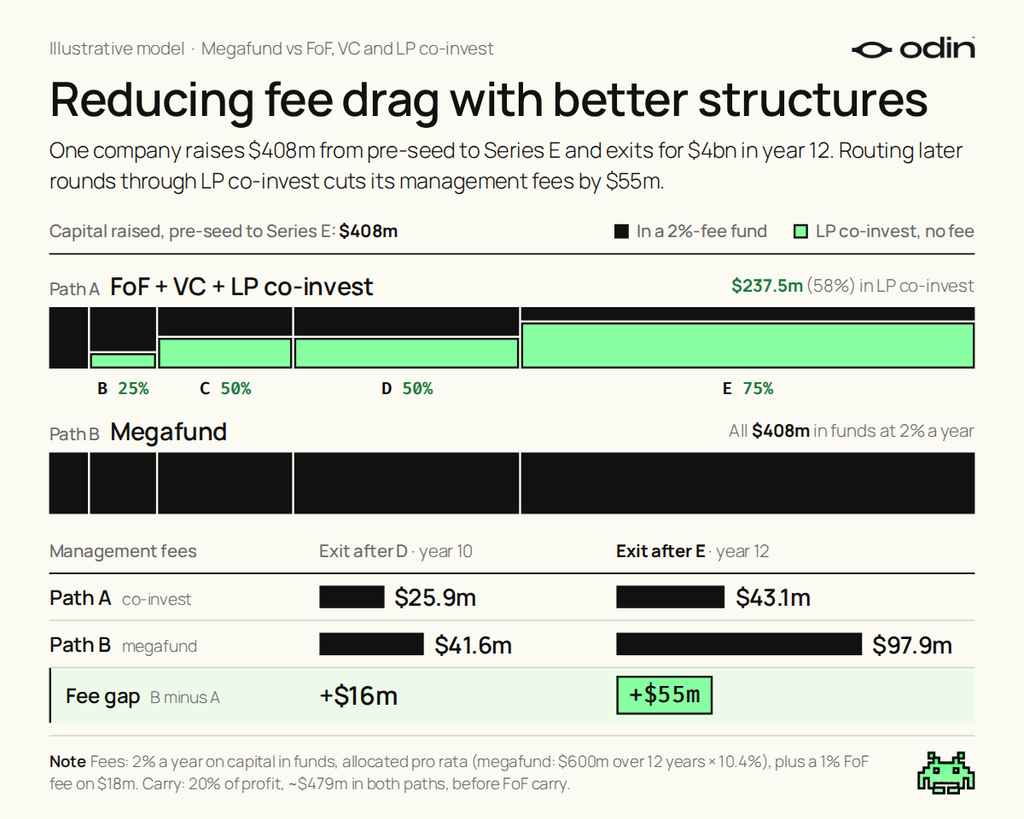
However, as LPs become more sophisticated about co-invest opportunities, they can get a similar level of access with little of the usual fee drag. Indeed, the shift toward much more substantial co-invest would dramatically lift performance across the market, which is why private equity also evolved further in that direction.
Finally, there is the simple truth that small funds outperform large funds, across every fund industry and in every study. According to analysis by Santé, funds of less than $350M are roughly 50% more likely to achieve returns above 2.5x, versus funds of $750M or more. Smaller funds generate a cumulative IRR of 17.4%, versus just 9.7% for the larger bracket.
“Mega-rounds have a higher floor & lower ceiling. They are less sensitive to improvements in exit rate & exit value. For traditional VC investments, a 10% increase in exit rate & 20% in average exit value generates an incremental 0.43x and 0.44x in Fund TVPI, compared to just 0.19x and 0.35x for funds investing in mega-rounds. Finally, mega-rounds are highly sensitive to the Market Regime and require an active IPO window to achieve the exit performance outlined here”
Why Venture Capital Does Not Scale (2023)
So, a fund of funds offers net outperformance already versus direct fund investing, it also enables a larger co-invest book for access without fees, and you make access to better-performing small funds viable for large LPs. In turn, the lower cost of capital is passed on to founders and reduces the risk associated with raising venture capital.
“Strategies for investing in direct funds may be constrained by limits on fund access or manager selection skills. We show that VC FoFs often outperform direct investing handicapped by these limitations.”
Financial intermediation in private equity: How well do funds of funds perform? (2018)
The outcome is a broad-based performance lift for LPs, and a more competitive industry that is better structured for finding and funding outliers. Stronger short-term returns by eliminating selection difficulties and fee drag, and a market structure that preserves long-term value creation rather than fee extraction.
Another interesting possibility arises out of this; the great hope of an algorithmic approach to venture capital.
The extreme idiosyncracy and unpredictability of venture investments means that systematic decision-making can at most exclude predictably bad investments. You cannot find succssful investments with a data-driven approach, because the successes are inherently outliers.
However, the same may not be true for investing at the LP level. Success as a venture capitalist may involve predictive traits or features which allow an algorithmic approach to offer an edge.
“Measures of fundraising success, although correlated to most fund characteristics, are not related to future performance. Meanwhile, machine learning tools can use qualitative information to predict future fund performance: the performance spread between the funds within the top quartile and the lowest quartile of predicted probability of success is about 9% per annum.”
Limited Partners versus Unlimited Machines; Artificial Intelligence and the Performance of Private Equity Funds (2024)
The implication here is that the fund of funds model is scalable in a way that venture capital is not. These vehicles may be the elastic buckets of market beta which large LPs have been looking for, and they don’t run the risk of cannibalising the long-term growth of the market.
On top of that, there’s a good argument for an intermediary layer which separates large institutional LPs from the managers. They aren’t exposed to reputational backlash if a manager they have selected invests in dystopian sex work platforms, crypto schemes or exploitative gambling applications.
This is not to say megafunds are going anywhere; they offer risk-averse institutions the big-brand trust of a KPMG or PwC. However, it seems inevitable that (as in other fund industries) their fee percentage is going to have to compress in recognition of the reality of their performance — which also raises questions about the persistence of their “access” edge.
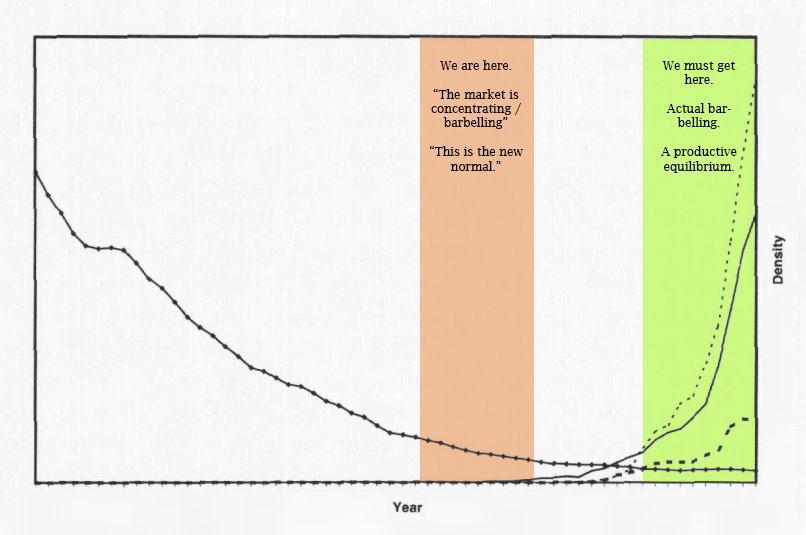
If the market returns to its earlier balance, with more capital being funnelled into small and emerging managers via fund of funds products, alongside the lower fee megafunds, it will be able to settle into a productive equilibrium. Whether that will look more like the mix in 2020, or in 2015, it’s hard to say, but the status quo seems unsustainable.
Top image: The Great Day of His Wrath, by John Martin (1851-1852)