A previous article discussed why venture capital has such a myopic focus on backward-looking metrics connected to ARR.
The summary is that people struggle with uncertainty, and there are two ways to cope: embrace it scientifically, or build a structure that lets people gamble on it.
Enter “casino culture”.
“Sports betting, shitcoins, meme stocks, vibe coding 100m in six hours, etc, are all expressions of the same deep cultural rot. If youth don’t believe there’s legitimate ways to get rich through work, all of culture will become a rotten sports book for the soul.”
If you want to bet on startups, ARR provides a convenient metric to compress complexity and uncertainty into one dimension, reducing venture capital to a simple horse-race.
Investors make bets on momentum categories, riding the wave of revenue driven by large injections of capital, and hope they can raise another fund or exit before the music stops.
“It’s very difficult to invest money well, and I think it’s all but impossible to do time after time after time in venture capital. Some of the deals get so hot, and you have to decide so quickly, that you’re all just sort of gambling.”
The beneficiaries of this limbic shift are the agglomerators, who play the role of “the house”; appearing to participate in the risk while harvesting beta from the associated activity.
For other investors, there are incentives to play:
Primarily, it gives GPs a simpler story to sell to LPs, inspiring greater confidence. They can enthusiastically shill consensus ideas and relationship-based access — which is exactly what many LPs want to hear, despite the poor returns.
Secondly, it diversifies away accountability. As more investors jump on-board the momentum train, individual career risk is exchanged for greater systematic fragility. When the market collapses, they can survive on relationships.
By turning venture capital into a game of chance, abusing the principal-agent problem, their job is greatly simplified: It’s the blue pill of steak dinners and congeniality, not the red pill of grinding hackathons and building portfolios.
Unfortunately, by abstracting the performance if investments from the underlying asset value with crude proxy metrics, the concept of “innovation” is mostly a mirage. It may be difficult to perceive at the time, when the traction feels real, but few truly important companies emerge from this environment.
Essentially, a category emerges as the focal point for venture allocation, concentrating capital, and participants begin flipping coins under the long-standing premise that the upside of winners is always much greater than the downside of losses.
In the end, everyone eventually loses — except the house.
It turns out that the very behavior they engage in is destroying returns, and the only winner is the person collecting fees to manage the bank.
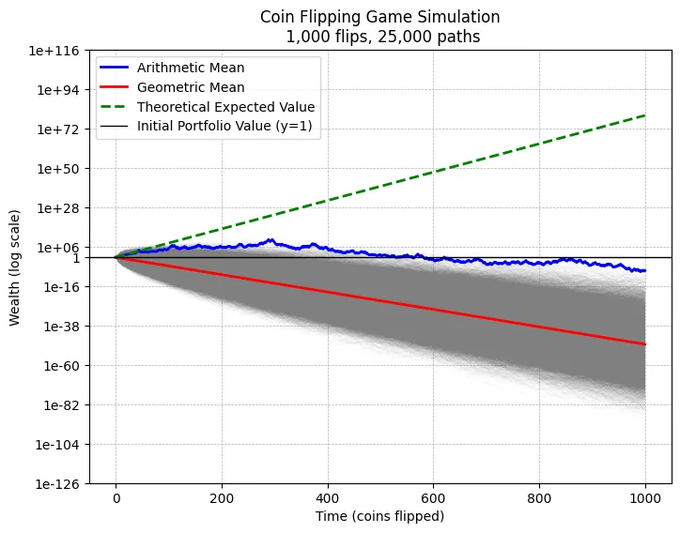
“Risk too much hunting jackpots and the volatility will turn positive expected value into a straight line to zero. In the world of compounded returns, the dose makes the poison.”
A rough example of the logic driving investment decisions amongst the most degenerate venture investors:
You’re evaluating a company with $7.5M ARR
$5M is net new ARR, annual burn is $10M
That’s a 2x burn multiple (BM)
You invest $30M at a market-rate of 20x ARR
Assuming 2x BM, $30M produces $15M in net new ARR
At 20x ARR, it gets marked up from $150M to $450M
On paper, that checks all the boxes: an investment that was subsequently marked up 3x using logic that could be decoded on an iPhone calculator.
Indeed, the role of multiples is to produce calculations that are easier and faster; to get deals done and put capital to work.
There are two major flaws with this approach:
The first is that multiples are backwards-looking. By applying to current revenue or burn, they rely on past performance. All assumptions about the future are squashed down into the multiple itself. Venture capital relies on making good judgements about the future, not the past.
The second is that multiples assume that all revenue is created equal. They ignore unit economics and capital expenditure, and nor do they fully appreciate churn. Finally, and particularly relevant today, they encourage founders to engage in creative accounting to boost ARR.
“We’ve actually come back to saying there’s a real advantage to seeng the GAAP revenue accounting, to make sure all the money is showing up for real.
There’s a lot of noise in that multiple, and when they were all SaaS recurring revenue businesses — all seat based, all 90% or 80% gross margin with no CapEx, all enterprise sales with low churn — it absolutely made sense. You could compare two companies. Thats’s why by 2019 or 2020 it almost felt like ‘fill in the form to give me the valuation’.
Consider, for example, the venture capitalist’s typical disdain for discounted cash flow (DCF) style thinking in valuation: There are too many assumptions, the future is too uncertain.
So, instead, they price with ARR multiples, which include all of the same assumptions about the future, but obfuscates them into simple calculation. Out of sight, out of mind.
“Some investors swear off the DCF model because of its myriad assumptions. Yet they readily embrace an approach that packs all of those same assumptions, without any transparency, into a single number: the multiple. Multiples are not valuation; they represent shorthand for the valuation process. Like most forms of shorthand, multiples come with blind spots and biases that few investors take the time and care to understand.”
Indeed, multiples are a popular tool precisely because they hide all of that detail. Remember, venture capital is (unfortunately) a game of building confidence with simple stories, not demonstrating competence with complex truths.
Financial engineering built on multiples is the bedrock of venture capital’s creeping financialisation.
Imagine you invest $20 in a company that generates $4 in ARR from each customer, with a CAC of $20. It trades at a multiple of 20x ARR.
In practice, that company is losing $16 on every customer in the first year, with payback over 5 years assuming no churn.
On paper, every $1 into the company produces $4 in marked value for the investor. It’s a great looking investment.
This is precisely the mechanic which incentivises insane capital consumption on negative unit economics. Investors trade financial health for faster markups, knowing that it’s a bust if the environment shifts.
“Guess what happened once Founders realized that VCs were valuing startups using revenue multiples? They started playing a game of Hungy Hungry Hippo with the goal of accumulating as much revenue as they could!”
…contributes to VCs losing the ability to build independent conviction, encouraging herd-behavior.
In conclusion, multiples are a tool for quick comparison across peers. Not for pricing, and not for understanding performance or potential of a startup. They include far too many important and unchecked assumptions, limiting an investor’s understanding of the specific future of a company.
Proper valuation, with multiples used as a sanity-check afterwards, is the way.
“We often pursue this kind of rationalization as a spot check, generally after going through the valuation process. When the multiple is implied, investors will then compare it to others seen in the public and private markets to get more comfortable. Think of it like a gut check, a way to determine if the valuation feels ‘reasonable’.”
Early-stage venture capital is characterised by uncertainty. Success lies in high-risk, non-consensus ideas that take many years to play out.
There are two ways that LPs grapple with this uncertainty, as institutional allocators to VC:
Seeking competence: managers that understand how to extract value from uncertainty.
Seeking confidence: managers that inspire the most certainty about future success.
For reasons best described by Daniel Kahneman, LPs are inclined towards the latter. This manifests as poorly managed risk; under-developed portfolio construction and overconcentration.
This is despite a large body of research illustrating the following:
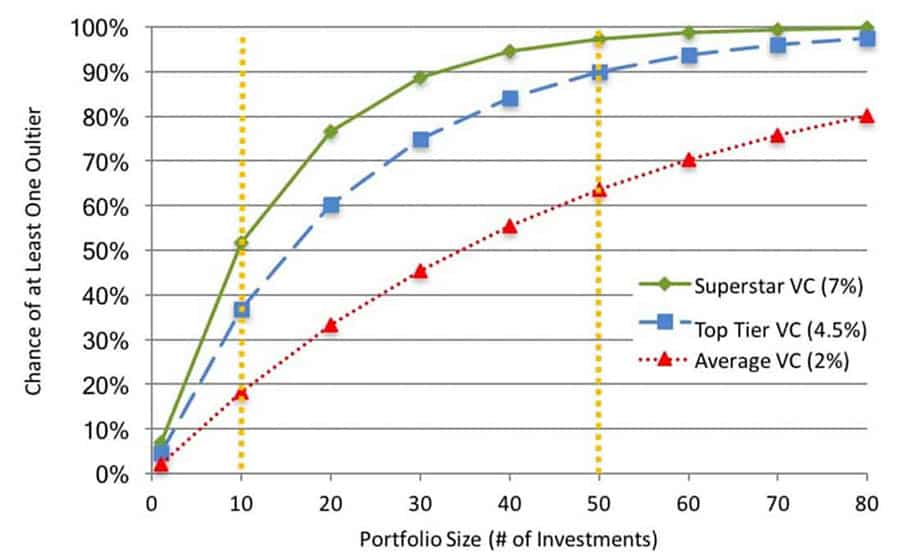
Diversification encourages VCs to take more idiosyncratic risk, which drives outperformance.
Indeed, this is not without precedent. Some of the greatest early-stage VCs have unusually large portfolios: Boost VC, First Round, BoxGroup and Precursor are obvious examples.
Despite the data, and the many anecdotal success stories, LPs are notoriously hesistant to back diversified strategies. By believing they can diversify at the LP level, across a portfolio of firms, they miss the systematic benefits of diversification and inhibit the compounding gains from process refinement.
Portfolio Maths
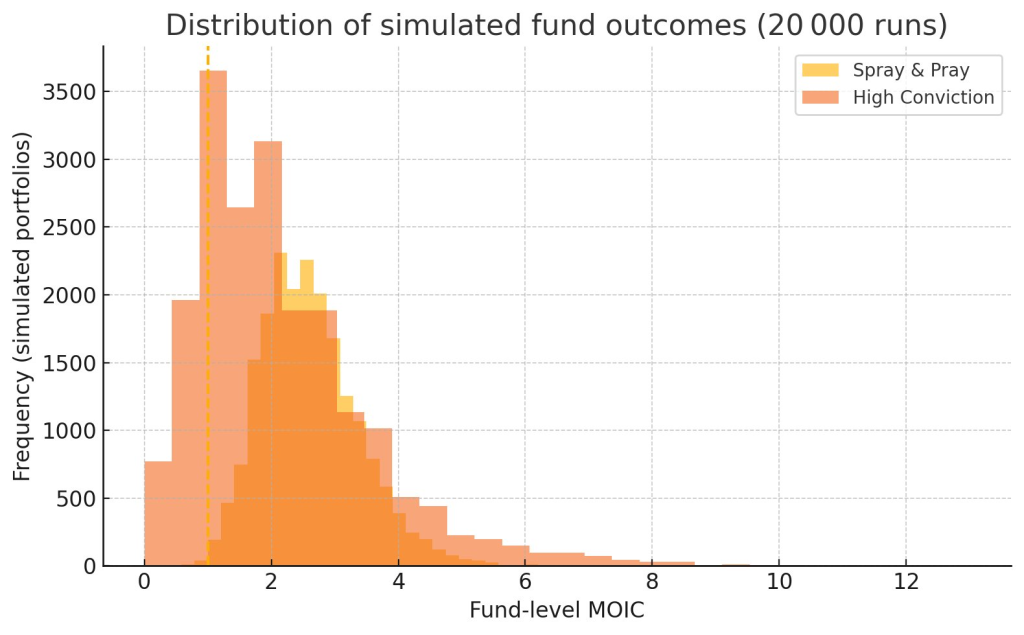
Earlier this year I posted a breakdown of expected venture capital returns based on simulating two seed portfolio models: one with 100 small checks, the other with 20 larger checks.
The graphic was meant to illustrate a simple point: based on a typical range of VC outcomes, the more diversified portfolio was likely to outperform, delivering a narrower and more attractive band of potential return scenarios.
“Typical” is the operative word there, as while the graphic implies the diversified portfolio wont exceed a 6x return, that’s only if you deliver average performance. It’s entirely possible for a GP to outperform in either strategy — although research indicates that the diversified portfolio is likely to have moreupside.
The statistical basis for this is simple: given venture capital’s reliance on outliers outcomes, the low probability and low predictability of those outcomes, it is more beneficial to make more investments (with lower ownership), than to have more ownership (with fewer investments).
The coversation that followed (credit to the always-insightful Peter Walker for sharing it with his audience) highlighted a deeper problem with the industry’s understanding of portfolio strategy, risk management and cognitive biases.
Overconfidence
A good place to start is Daniel Kahneman’s work on cognitive biases in investing:
“The confidence we experience as we make a judgment is not a reasoned evaluation of the probability that it is right. Confidence is a feeling, one determined mostly by the coherence of the story and by the ease with which it comes to mind, even when the evidence for the story is sparse and unreliable. The bias toward coherence favors overconfidence. An individual who expresses high confidence probably has a good story, which may or may not be true.”
As a crude summary, imagine an LP speaks to two VCs:
One says they’ll invest in 100 companies and expect that ~75 of them will be be writen-off. The fund returns will primarily hinge on ~1-5 investments.
The second explains that they have a powerful network advantage, and they’ll deliver huge returns from concentrated ownership in just 15 companies.
The LP is likely to go with the second VC, who builds more confidence by telling a simpler and more coherent story; they simply have access to “better investments”. What’s not to love?
And few investors demand diversified funds, so GPs don’t offer them. A slow and steady “venture is a numbers game” pitch is much less emotionally compelling than “I am a rock star who can consistently beat the odds.” And GPs need an emotionally appealing pitch to get funded.
LPs want to hear confidence, so that’s what VCs offer. Thus, “overconfidence” is by far the most prevalent and dangerous cognitive bias in VC behaviour.
This mode of favouring confidence over competence leads to a number of dogmatic beliefs amongst the LP community:
That relationships drive better investments in VC — which is only vaguely true in hot markets when it’s easy to collect markups from your friends.
That venture capital funds themselves operate with power law outcomes — which is only true because of the unnecessary and toxic levels of concentration.
That VCs are supposed to “pick” their way to success — rather than relying on well designed origination strategies and a systematic approach to capturing outliers.
Overconcentration
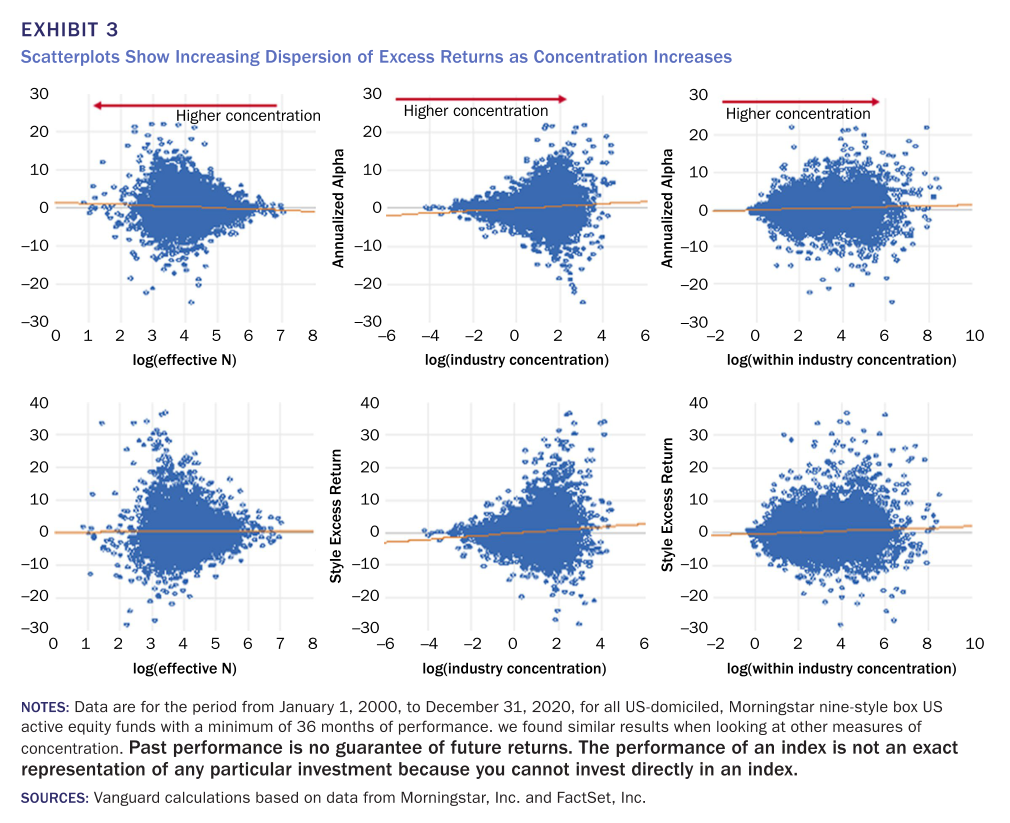
Overconfidence primarily manifests as overconcentration; portfolios with poorly managed risk. Too much capital, concentrated into too few investments, with high levels of uncertainty. This is typically measured with the Sharpe Ratio in grown-up investment strategies.
The influence of concentration is obviously double-edged, as it compounds both good and bad investment decisions.
However, research shows that this amplification is not evenly distributed: overconcentration hurts underperformers more than it helps overperformers.
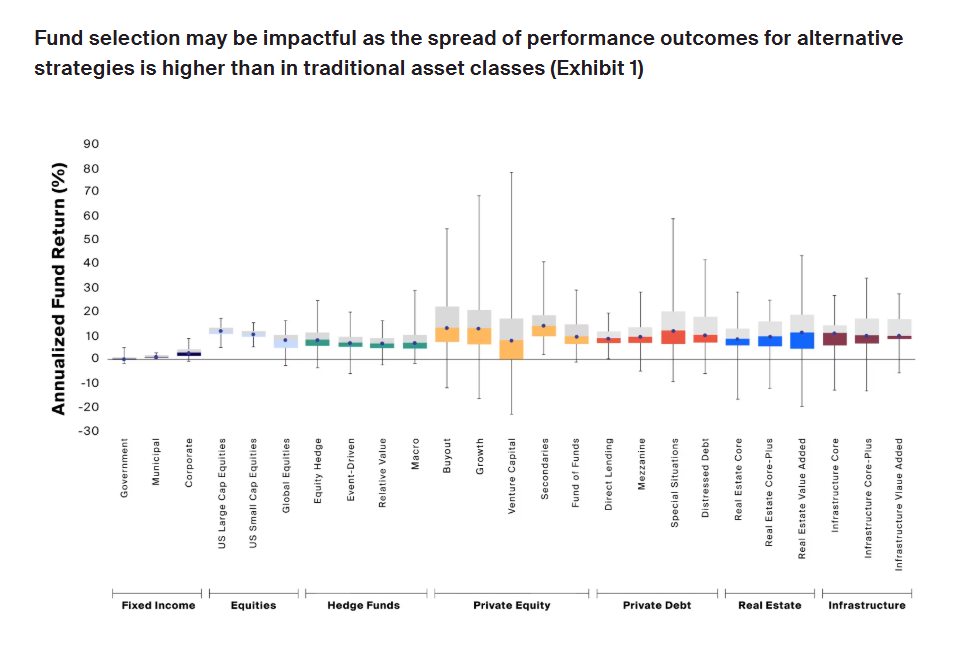
So, if venture capital were systamatically overconcentrated, you would expect to see a wider distribution of returns and a lower average return, relative to other strategies. As it happens, that’s an accurate description:
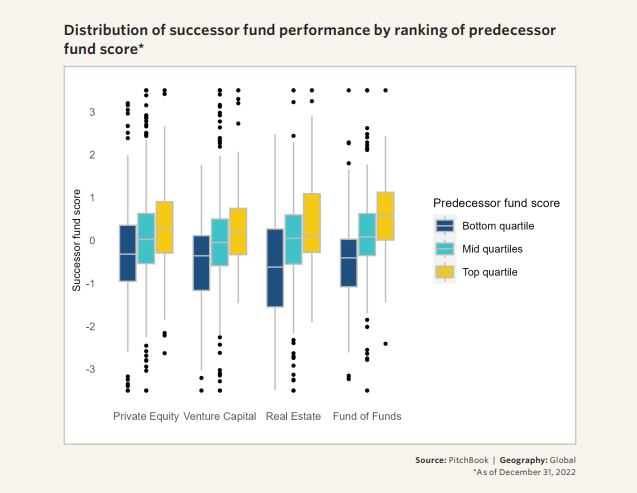
There’s a good argument that the poor persistence of performance in venture capital can be attributed to shallow narratives around “picking” which undermine basic theory around portfolio construction and behavioral economics.
Not only does this damage persistence, it’s particularly toxic for new entrants who may attempt to piece together a strategy from the “common wisdom” available to them.
Instead of being encouraged to adopt practices that are optimal for more consistent above-benchmark returns, emerging managers are pushed toward the “rockstar” narrative of outsized promises.
You might raise an eyebrow at this, if you are familiar with the history of venture capital incumbents strategically freezing out new entrants in order to maintain advantageous pricing power.
Intitutional Insecurity
“Perhaps the most powerful lesson from Marks is the idea of ‘uncomfortably idiosyncratic’ investing. Citing the late David Swensen of Yale, Marks emphasizes that successful investment management requires taking positions that feel uneasy because they go against the grain.”
If investment performance is driven by adopting “uncomfortably idiosyncratic” positions, it’s reasonable to assume this is especially true for early stage venture capital — where non-consensus investing drives outperformance.
“You will know you are doing real venture capital when you aren’t competing with other investors to finance a deal but are instead offering to invest in people, industries and ideas that don’t yet have access to capital. That is where money can be most useful, and also where returns can be the highest.”
VCs take a systematic approach to managing idiosyncratic risk through portfolio construction; optimising for larger outcomes and failure rates than other strategies. Indeed, VCs with larger portfolios appear comfortable accomodating more idiosyncratic risk, which ultimately contributes to stronger performance.
In fact, you could probably summarise the VC strategy as the art and science of systematically extracting value from idiosyncracy.
The lingering question, given all of this evidence, is why aren’t larger early-stage portfolios the default in venture capital?
The answer is agglomerator-leak; the “loudest model” of the mega-funds, which ends up influencing practices and perceptions across the whole venture market.
For example:
When you are investing billions in each cycle, you must pry your way into hottest companies of each vintage. The future of your firm depends on those bloated private-market darlings, and there is significant career-risk associated with missing them.
Thus, a number of ideological artefacts are spawned:
“You must be in the category winners, at any cost.”
“Only a handful of outcomes drive returns for each vintage.”
“Concentrated ownership drives outperformance.”
These artefacts latch onto insecurity like Pinterest self-help quotes. GPs and LPs looking for confidence through coherence, biased toward simple ideas, lap up this accessible wisdom from venture’s most influential characters.
Unfortunately, it means they apply the same thinking to early-stage investing, and much smaller funds operating a very different strategy, even when all evidence suggests that’s a very silly thing to do.
Process Alpha
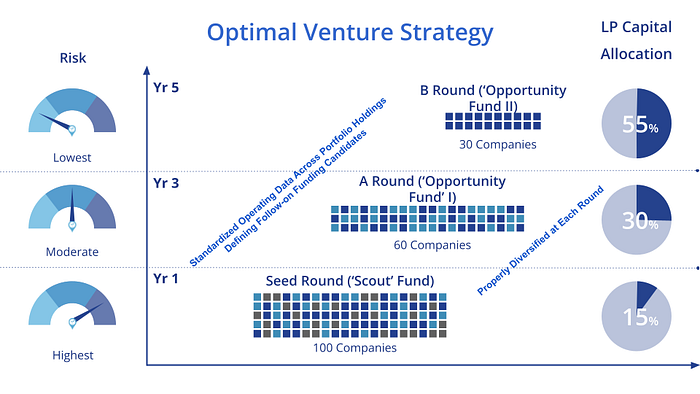
From a well-diversified base of initial investments, it is possibe for a VC to double-down on winners over subsequent rounds. This is a process that Joe Milam, founder of AngelSpan, has dubbed “process alpha“.
Staging your capital deployment properly over multiple rounds dramatically improves the IRR for investors, regardless of the MOIC/DPI. And given the natural failure rates of startups (usually within the first 2 or 3 yrs), optimizing on how much you invest in each round improves the risk-adjusted returns available.
Essentially, this is how a VC can take the solid foundation of a well diversified initial portfolio and then build on that position with staged deployment into the best opportunities that emerge in subsequent rounds.
Conclusion
While it’s difficult to get into specific recommendations, it seems safe to make the case that early-stage venture capital firms should probably be significantly more diversified.
More importantly, the LP:GP interface is clearly problematic, and LPs need to think carefully about whether they bias towards confidence over competence.
In order to do so, they must grapple with the economic theory, and the reality of portfolio construction, to recognise why it’s important that there be a good level of diversification at the VC portfolio level.
“You should not take assertive and confident people at their own evaluation unless you have independent reason to believe that they know what they are talking about. Unfortunately, this advice is difficult to follow: overconfident professionals sincerely believe they have expertise, act as experts and look like experts. You will have to struggle to remind yourself that they may be in the grip of an illusion.”
There is no shortage of think-pieces on the state of venture, bemoaning concentration, slipping returns, and the challenging environment for smaller managers.
Few have tried to answer the underlying question:
The perspective that VC consolidation is poisonous for both innovation and returns is slowly but surely becoming mainstream.
Can’t wait for this to become a given so we can (finally!) move onto the much more interesting topic of “What comes next?”
First, the most concise formulation of the problem:
LP allocation to “VC” grew so quickly that there was no opportunity for the strategy to adapt and properly allocate the additional capital. Instead, it was captured by opportunists.
Thus, a majority of today’s “VC” activity is simple financialisation.
Venture capital involves making long-term investments in innovative, high-growth companies, with the goal of capturing outlier returns at exit.
“VC” is the process of using financial engineering to optimise fee income. Maximising proxy performance metrics by manifesting herd-like market momentum.
“VC” isn’t intrinsically bad: the agglomerators are responsible for pulling billions of dollars into technology investment, by developing a product suitable for the largest and wealthiest LPs with the lowest expectations.
However, there are three points the market needs to grapple with in order for venture capital to move forward:
1. Agglomerators have no business investing prior to Series C
The argument for their existence is that technological development often requires vast pools of growth capital, so why do they invest at seed?
The truth is rooted in financialisation: it’s easier to produce a mirage of proxy metrics if you can pick startups that fit the momentum narrative, and founders that will go along with it.
Another part of the reason is that these firms are doing very nicely from absorbing capital in the “VC” allocation bucket. Registered RIAs moving further away from early-stage investing might invite some unfavourable comparisons to their PE peers.
Indeed, exactly whose allocation are they displacing? Is it venture capital? Or is it the PE firms they maybe more closely resemble? Or is it the public markets they have drained of new growth opportunities?
We also know:
The hypercapitalising behavior of these large firms systematically breaks young startups.
They poorly built for early-stage investing, as large firm dynamics favour more obvious investments.
A decade of deal activity shows these firms are actively concentrating into consensus anyway.
The early-stage activity of these firms achieves very little of any merit. They bend the market to their consensus narrative, suffocate genuine innovation, and turn startups into volatile commodities in their hunt for “market winners”.
2. The agglomerator model of “VC” is an experiment
For all that many of these firms are well-established names in the venture capital ecosystem, their strategy is not.
In describing this bifurcation of the venture market, back in 2020, Nikhil Basu Trivedi stated “the next decade will be a referendum on agglomerators“. Essentially, until we see how these multi-billion dollar funds play out, it’s unclear what future the strategy has.
Indeed, we can learn from history: after the dotcom bubble burst, the industry collectively swore off >$1B funds (for a while), with GPs reflecting on the challenges of scaling venture capital.
There are similar lessons from the history of “mega-buyout funds”, as described by Meghan Reynolds of Altimeter:
“Mega Fund dynamic in VC mirrors the meteoric rise of Mega Buyout funds in ’05-’08. Post GFC, Mega Buyout went out of favor w/ many LPs. What happened after was an emergence of strong, highly sought after <$2B “middle market” funds that were thought to have greater alpha.”
3. Agglomerator practices have corrupted venture capital
Perhaps the most painful and pernicious aspect of all of this, is that the conflation of these multi-stage agglomerators with venture capital has led to a corruption of standards and practices.
Let’s be clear: venture capital has very little in the way of standards and practices. What there is, tends to be a mimmicry of “the loudest model“, which is the agglomerator playbook.
So, when they say things like “entry price doesn’t matter”, or “non-consensus investing is dangerous”, or “the only thing that matters is getting into the best deals”, they are talking their book. It reflects a strategy that simply does not apply to venture capital, where entry price does matter, all alpha is non-consensus, and nobody can predict the best deals.
The same is true for LPs, who derive much of their understanding of venture capital, and what “good” looks like, from these “loudest models”: When Marc Andreessen says “AI will save the world”, LPs demand that GPs have an AI thesis, even when a smart GP may be looking beyond that horizon, or at overlooked alpha elsewhere.
So, what comes next?
Hopefully, a number of things play out over the next five years:
We see the limitations of the agglomerator model, and venture capital can reclaim the early stage, yielding more effective and diverse origination with saner pricing and less volatile outcomes.
LPs slowly wise-up to this bifurcation of strategies, re-educate themselves about venture capital, make better allocation decisions and feel less inclined to impose upon GP strategy.
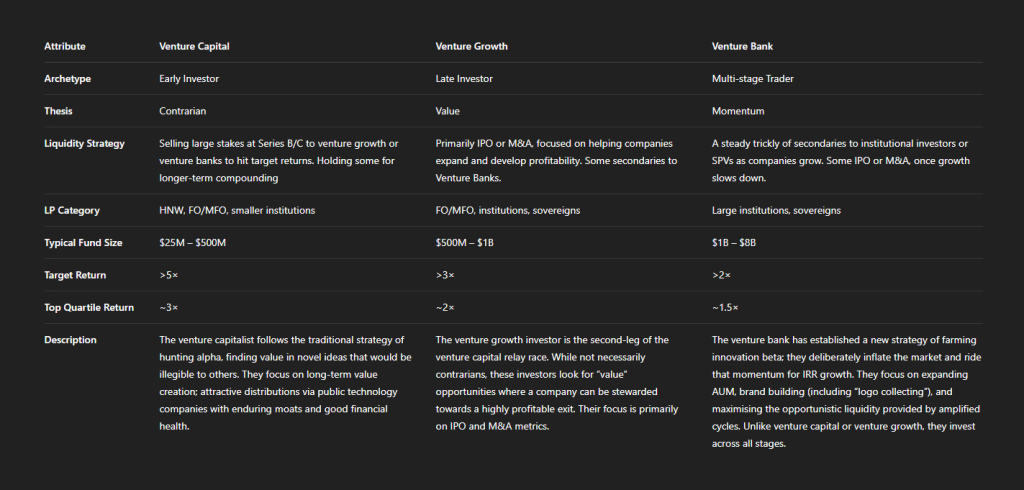
Agglomerators (re-classified as “venture growth”) become a defined sub-category of LPs private book, like venture capital. Publications like Pitchbook and CA start disaggregating performance into this new bracket.
Anyone who wants to play a fee-driven financialised game can go to venture growth, those who are driven by performance and impact can work in venture capital. Two different systems, each better understood and playing to their strengths.
Increasingly, venture capital will be able to tap into venture growth for liquidity as their portfolio matures, accelerating liquidity and feedback cycles to produce compounding performance gains.
Slowly but surely, venture capital may return to being a better-performing and more positive-sum strategy, focused on finding outliers and the discipline of properly managed risk. Less herd behavior, and less cognitive dissonance.
(top image: Meindert Hobbema’s The Avenue at Middelharnis)
Whether you’re investing in mature companies in the public market, or fast-growing startups in the private market, one question separates good and bad investors:
Do you understand valuation?
Valuation is the rationale by which you determine which opportunities to pursue. To develop your understanding of valuation is to develop your ability to recognise potential.
Despite the central role in investment decisions, valuation is often misconstrued as financial engineering or market-driven pricing exercises.
Valuation is an opinion
Here’s three things valuation is not:
Based on verifiable inputs
Provably accurate in output
A mirror of market sentiment
Instead, valuation is always an opinion based on a set of assumptions about an unknowable future.
“People act like it’s an award for past behavior. It’s not. It’s a hurdle for future behavior.”
Whether that valuation is based on a detailed DCF model or napkin-math, it’s an opinion. And it’s no more or less of an opinion as your process gets more or less sophisticated; the only difference is how clearly you outline the assumptions.
When one investor states that a company is overpriced, and another that it is undervalued, neither is right or wrong in the moment — they just have differing opinions.
Valuation can be a simple, implicit part of the process, or it can be an explicit exercise used to better understand an opportunity and check assumptions.
Valuation is a story about the future
In order to form an opinion about a particular future, you must first listen to its story.
“The value of a stock is what people believe it is and could be. A stock is a story.”
Valuation is the art of using stories to develop opinions about the future
Valuation can be broken down into a few pieces:
How do you judge the credibility of a story?
How do you estimate the economic potential of a story?
How do you estimate the risk associated with a story?
You can think about this via two extremes:
You’re looking at a company you’re familiar with. You’ve got a good mental model of the industry, the technology, the market forces, trajectory, and risks. It’s relatively simple for you to make a rough judgement on value in your head. This reflects Kahneman’s “System 1” thinking.
You’re looking at a company you have no familiarity with. The technology is novel, the market is emerging, and there’s no real precedent. In order to make a good judgement, you have to submerge yourself in details and scenarios. This reflects Kahneman’s “System 2” thinking.
In the latter case, a more sophisticated valuation process can help you understand the credibility and economic potential of a story. It provides a framework for ingesting information that can control biases, while allowing you to recognise and scrutinise the main drivers of value.
Valuation is essentially the act of running simulations of the future described in a story, focused on the numbers rather than the narrative, to explore the potential.
Pricing is not valuation / Trading is not investing / The present is not the future
Venture capitalists often choose to focus on relative pricing, instead of valuation, as an attempt to proxy experience through crowdsourced activity — allowing for speedy “System 1” style investment decisions.
This means analysing industry activity, which biases investment towards categories with low information friction like B2B SaaS, at a cost to sectors with more idiosyncracy, like deeptech.
Unfortunately that focus on market data also means these investors are not developing their ability to make judgements about the future, only to pattern match today. This compounds into a ‘knowledge worker atrophy‘ problem, weakening venture capital’s institutional competence at funding creative endeavors and novel solutions.
That would appear to be a critically weak link in the value proposition of venture capital, and the premise that it funds important solutions to humanity’s problems.
Relying on market efficiency while investing in idiosyncrasy
Venture capital is the hunt for outliers; ideas that are not well understood by the wider market. This strategy is rooted in the need for risk capital to finance frontier businesses.
You can see how this played out in previous generations of tech: Amazon, Airbnb, Canva, Coinbase, Dropbox, Google, Shopify, Slack, Uber… All of these companies faced an uphill battle with investor interest, and went on to produce incredible exits for the early believers. Similarly, there are many examples where the founder’s own capital paved the way: SpaceX, Tesla, Palantir, Anduril…
On the other hand, it seems relatively more difficult to find stories of competitive early rounds leading to great outcomes. Stripe, perhaps?
This understanding of venture capital is reinforced by the data:
We find that consensus entrants are less viable, while non-consensus entrants are more likely to prosper. Non-consensus entrepreneurs who buck the trends are most likely to stay in the market, receive funding, and ultimately go public.
Despite this, today’s venture capitalists have an absurd reliance on the market as their lens to understand value. Herd behavior drives investor attention, and (what passes for) valuation is primarily derived from relative measures like ARR multiples.
Investors set out to generate alpha with their unique ability to recognise novel opportunities, but rely on broad market sentiment as a lens to understand what is worth pursuing.
This paradox has stumped observers.
This heavy reliance on comparable companies in the VC valuation process is perhaps unsurprising, given that relative pricing methods are not uncommon in M&A markets overall. What is less clear, however, is the exact driver behind this method, and the understanding of why a relative pricing methodology will impact startups’ valuations.
Whether it’s marketplaces, crypto or today’s AI boom, capital herds into the category and drives up prices, and those prices then become “comps” for others.
Ultimately, the surge in deals creates a greater volume of market data for that category, reducing information friction for investment, allowing for more deals to be made more quickly. This compounding influence quickly overheats activity.
In addition to competition driving up prices and compressing due diligence timelines, there’s a further pernicious consequence: while information friction is reduced around the consensus, it is increased elsewhere.
Founders building truly innovative products find themselves facing a wall of blank-faced investors programmed with category multiples. The difficulty of raising capital becomes so great that many simply reorient their ambition to lower quality projects closer to the experience of venture capitalists. This is clearly a fundamental failure:
Information frictions in valuation can lead startups to select projects that align with the expertise of potential venture capital (VC) investors, a strategy I refer to as catering […] where a startup trades off project quality with the informational benefits of catering.
If all of this was to hold true, we should see an increase in performance by the few VCs that maintain a lens on fundamental (rather than relative) value. In theory, these investors would be better able to recognise outlier value and unique opportunities.
Indeed, that does appear to be the case. Multiple studies on venture capital investment performance and decision making processes have reached the conclusion that VCs would benefit from a better understanding of fundamental value:
Venture capital funds who base their investment strategy on fundamental values and a long-term view seem to have a measurable advantage over those who engage in subjective short-term trading strategies.”
Ideally, a startup would combine a full fledged fundamental cash flow-based approach with a thorough comparable companies analysis to cover both its intrinsic value and a market-based measure.
So, the paradox is laid bare and the remaining question is why this is the case. There are two potential explanations:
VCs do not understand valuation. A decade of ZIRP-fuelled spreadsheet investing has destroyed the institutional understanding of risk and the purpose of venture capital.
There are other incentives at work which explain this phenomenon; reasons why VCs would be reluctant to closely analyse fundamental value.
Explanation 1: Hanlon’s Razor
Unsurprisingly, there’s plenty of evidence to make the case that this is unintentional; a result of simple incompetence and herd behavior. Indeed, herding is a well-studied phenomenon in professional investment, particularly when insecurity is high:
Under certain circumstances, managers simply mimic the investment decisions of other managers, ignoring substantive private information. Although this behavior is inefficient from a social standpoint, it can be rational from the perspective of managers who are concerned about their reputations in the labor market.
Chronic groupthink, and the atrophy of independent reasoning, further explains why VCs are also often unable to clearly articulate the process that goes into their investment decisions:
The findings suggest that VCs are not good at introspecting about their own decision process. […] This lack of systematic understanding impedes learning. VCs cannot make accurate adjustments to their evaluation process if they do not truly understand it. Therefore, VCs may suffer from a systematic bias that impedes the performance of their investment portfolio.
Many VCs have simply emulated the practices of their peers without fully understanding why. Indeed, those peers probably couldn’t provide a rationale either. It’s an industry of investors copying each other’s homework while pretending to be original thinkers.
Action without understanding purpose naturally erodes standards. Not only does this make VCs bad fiduciaries, it also precludes any learning and institutional development.
Almost half of the VCs, particularly the early-stage, IT, and smaller VCs, admit to often making gut investment decisions. We also asked respondents whether they quantitatively analyze their past investment decisions and performance. This is very uncommon, with only one out of ten VCs doing so.
The alternate theory is that there may be some genuine motive for VCs to avoid looking too carefully at fundamental value. That somehow they are able to profit from a reality in which it is not an important driver of activity.
Perhaps it is simply because today’s VCs behave more like traders, rather than investors. That the easier opportunity is to glom onto hot categories and ride the exuberance to an overpriced exit somewhere down the line, rather than trying to find good investments.
This is also not an original accusation:
For those who are holding on to the belief that venture capitalists are the last bastion of smart money, it is time to let go. While there are a few exceptions, venture capitalists for the most part are traders on steroids, riding the momentum train, and being ridden over by it, when it turns.
Venture capital, as a discipline, runs an existential risk of invalidating itself by becoming institutionally what crypto is colloquially. If venture capital is just about “[creating] the impression [of] recoupment”, then its no better than the pump and dumps of the crypto bros.
Yet again, there’s evidence that this is the case.
VCs are heavily influenced by market conditions, optimism and FOMO. None of these are original accusations, although it might be interesting to learn this has been demonstrated in research:
The optimistic market sentiments and fears of missing out in hot markets can significantly shift VCs’ attention towards cheap talk, such as promises of high growth. Such conditions may even prompt VCs to neglect costly signals such as the profitability of new ventures.
This is confirmed by research looking at this question from the other side, where it is demonstrated that VCs are commensurately less likely to herd in periods with greater uncertainty and less optimistic momentum to channel capital:
The study finds a significant negative relationship between economic policy uncertainty (EPU) and herding behavior, indicating that venture capitalists are more likely to make independent judgments when EPU rises.
Even when a VC talks about wanting to find category winners, they are also implicitly talking about riding a category. Were they hunting for genuine outliers, the category wouldn’t matter. There is a reason, for example, why some VCs widely publicise the categories they invest in as great opportunities, and others choose to keep any alpha for themselves.
The final reason is simple: subjective, market-based pricing is opaque and open to manipulation. VCs can collectively produce and support higher marks regardless of underlying value. They can also choose to be “opportunistically optimistic” about a portfolio company:
During fundraising periods the valuations tend to be inflated compared to other periods in the life of the fund. This has large effects on reported interim performance measures that appear in fundraising documents. We find a distinctive pattern of abnormal valuations which matches quite closely the period up to the first close of the follow on fund. It is hard to rationalize the pattern we observe except as a positive bias in valuation during fundraising.
Indeed, much of the fallout post-2022 involved LPs feeling fairly miffed that managers weren’t being honest about underlying portfolio company value. As long as VCs broadly maintained marks, there was still hope to raise another fund on those mostly meaningless proxy metrics of performance.
In Conclusion,
Many VCs choose to play a short-term trading game By focusing on market momentum, rather than companies, through relative valuation methods, VCs operate more like traders.
Most VCs take the path of least resistance when adopting practices While analysing fundamental value offers outperformance, relative value is easier to understand and offers strategic advantages.
Most VCs identify as investors, and some of them still are. Mostly the smaller, boutique firms who were quick to realise that they could not compete in consensus categories against the multi-stage platforms.
There is value in being a trader if you have multi-billion dollar funds and can both manifest and then coast on the beta of technology markets. They behave like market makers on the way up, extracting opportunistic liquidity, and can aim to concentrate resources into the handfull of winners before the market turns.
This strategy is toxic to smaller investors, many of whom are simply washed out in the boom-and-bust cycles that this amplifies. Instead, these investors, focused on identifying true outliers, need to consider polishing their lens on fundamental value.
(top image: Ascending and Descending by M.C. Escher)
The two faces of what we sometimes call venture capital, and the cognitive dissonance they create.
This blog started out as a place to write about the intersection of science fiction and technology. The first article about venture capital, and the opium of consensus, emerged from watching VCs herd into thinly-veiled crypto scams in the name of “web3“.
The influence of consensus remains poorly understood, and the subject of distracting counterfactuals, despite being widely discussed for as long as “investor” has been a profession.
Words must have meaning
Venture capital is the practice of identifying nascent business opportunities with radical potential; the application of process to extract outsized value from extreme idiosyncratic risk.
In this context, venture capital is clearly not a consensus-oriented discipline. Both theoretical and quantitative perspectives support this reality; the intention, goals, behavior and performance.
We find that consensus entrants are less viable, while non-consensus entrants are more likely to prosper. Non-consensus entrepreneurs who buck the trends are most likely to stay in the market, receive funding, and ultimately go public.
Simply look back at the early-days of venture capital’s largest outcomes, where the majority did not have investors competing for access, driving up the price. Fundraising was a struggle for those founders, and in that struggle was the opportunity for those on the other side of the table.
It’s very hard to make money on successful and consensus. Because if something is already consensus then money will have already flooded in and the profit opportunity is gone. And so by definition in venture capital, if you are doing it right, you are continuously investing in things that are non-consensus at the time of investment.
Indeed, if consensus were to play a meaningful role in venture capital, it would fail on the only two things it sets out to achieve:
Maximise ROI for LPs through idiosyncratic risk
Finance the development of novel innovations
In addition, there is no such thing as a downstream supply of “non-consensus capital”. If you fund non-consensus companies then you have to be able to support them to the point where their potential is obvious and larger/later generalists can be convinced. It’s paradoxical to believe that other investors will share your non-consensus viewpoint.
Cognitive dissonance
The root of the confusion about consensus (and entry price, portfolio construction, attention, relationships…) is the mixing of two different private market strategies. One is venture capital, and the other is something else that just falls into the venture capital allocation bucket.
This other strategy emerged in the period from 2011 to 2021, enabled by low interest-rates, as described by Everett Randle in “Playing different games“:
Tiger identified several rules / norms / commonly held ideas in venture/growth that are stale & outdated and built a strategy to exploit the contemporary realities around those ideas at scale.
So you have massive capital allocators looking for places they can farm yield and they don’t want to be slinging hundreds of $30M checks. Capital agglomerators represent the perfect solution. Hit your 7-8% yield target, be able to park $250M a pop without being the majority of the fund, and sit back and relax.
This hunger to capture the most extreme “power law” category leaders is a requirement of the exit math involved in multi-billion dollar funds. Consequently, these platforms also raise substantial early-stage funds to index any emerging theme, putting an option on the future of those companies.
A mega-VC with $5-10B annual funds is really searching for only one thing: a company they can pile over $1b into with a potential for 5-10X on the $1b. With this, seed fund is inconsequential money used to increase the odds of main objective.
The startup industrial complex that has emerged is not optimised for non-consensus investing, and nor does it need to be. Investors at these platforms are hired to compete and win in known areas — and have attitudes to match:
Successful startups fit into a mold that investors understand, and that more often than not those startups attracted meaningful competition among top investors.
If a company has tons of hype and seems overvalued, don’t run away. Run towards it. Hype is good. Means they’ll raise, exit at higher valuation. And the price likely won’t feel overpriced after the startup exits.
The output is a rough index of high-growth private technology companies. The platforms are harvesting the beta from innovation, rather than finding the alpha in outliers. Even the giant outcomes become so well/over-priced that their returns risk converging with benchmarks.
Categorically, this is not venture capital in any meaningful sense.
The only reason we call this venture is because LPs need to call it venture so CIOs can hit annual allocation targets they promised boards. This is venture allocation, not venture returns.
To repeat a point already well-hammered, the platform strategy is entirely different, with a different LP base, a different return profile, and different rules.
The difference between the Andreessen quote above, and the more recent quotes from Chen and Casado, is simply that in 2014 Andreessen Horowitz was a venture capital firm. Today it is an asset manager, an RIA with a multi-stage platform strategy, perhaps best described as a venture bank.
Many VCs have sought to assimilate “tier 1” multi-stage behavior, acting out what they believe LPs and peers expect to see despite the fundamentally incompatible models. This herding around identity and behavior reflects the extreme level of insecurity in venture capital, a product of the long feedback cycles and futility of trying to reproduce success in a world of exceptions.
There is no harmony with venture capital, and the behaviors of these platform investors should not be emulated by venture capitalists — whether or not they also call themselves venture capitalists.
To put a point on this: The platforms explicitly benefit from consensus and price inflation. Both are toxic to venture capital.
As long as both strategies are discussed under the banner of venture capital, we’ll keep wasting time on pointless debates about markets and incentives, and investors will keep making dumb, confused decisions.
(top image: A Steam Hammer at Work, by James Nasmyth)
One of the concepts we emphasize at Equidam is the inversion of qualitative and quantitative factors in startup valuation, as you go from Seed1 to pre-IPO funding.
The archetypal Seed startup (perhaps just an idea) has nothing to measure. Investors must use their imagination, peer into the future, project a scenario. On the other hand, a startup raising the last round of private capital before an IPO will be weighed and measured almost entirely on financial metrics.
Even as early as Series A you have access to some useful data. Can they actually build the thing? Do customers really want it? Does anyone want to work there? All sources of rich signal to help you make an objective decision about the company.
Seed is different. Success comes down to the quality and consistency of your subjective, independent judgement. In many ways it is a unique discipline within the strategy of venture.
What happens if you try to find a path in the data?
Essentially, it’s a hunt for outliers with no shortcuts and two specific qualifiers for any investment strategy:
Any attempt to pattern-match to past success is going to dramatically limit your pool of opportunity, with no clear upside.
Any constraints built into your investment strategy (sector, region, industry) are essentially a sacrifice of volatility (potential alpha).
Thus, the ideal Seed investor is likely to be a generalist, with no preconceptions about what great founders look like, where they come from, or what they might be building.
Rather than the hubris of a (supposed) rockstar stock-picker, Seed investors will find confidence through constructing solid processes, systematically rewarding good decisions and mitigating bad ones.
Finally, and perhaps most importantly, they’ll have a firm grip on the biases which manifest in all forms of investing. Particularly the curse of overconfidence which erodes the positive influence of success.
In summary, considering all of the above, we should expect Seed investors to present with an idiosyncratic worldview, some robust fundamental skills and an appetite for risk.
Sadly, reality is the opposite: Seed investors are often risk-averse herd animals with little real competence. They have Rick Rubin-esque affectations, pontificating on ‘taste’ and ‘craft’, while copying each other’s homework and hiding deep insecurity.
In the last 15 years we’ve seen the emergence of a Startup Industrial Complex, where a treadmill of capital, services and brand-strength was offered to participating firms and startups. If you wanted quick, reliable markups and easy downstream financing for your portfolio then you hopped on board.
This movement destroyed the institutional contrarianism of Seed investing. Billions of dollars were piled into safe SaaS money-printers when capital was cheap. When the market for safe investments was saturated, investors responded by dumping huge sums of capital into silly ideas (remember NFTs?).
That’s “risk”, right?
This worked during ZIRP, because everything was going up and to the right. Public markets were so cracked-out on COVID and cheap capital that they grabbed anything at IPO. But it was never going to last.
Seed VCs (and their LPs) need to recognise that role is, and always has been, to find breakout companies before they are obvious. Not to compete for deals. Not to seek validation from colleagues. To find those outliers. To be uncomfortably idiosyncratic. That’s it. That’s everything.
Critically, while it may lag by a decade or so, everything else is downstream from Seed.
The entire venture capital strategy depends on Seed investors doing their job properly. The entire premise of venture-backed innovation, and the promise of venture-scale returns, are entirely dependent on the health of Seed.
(image source: “Venice; the Grand Canal from the Palazzo Foscari to the Carità”, by Canaletto)
The story of venture capital (and its precursors) is a story of risk. You can take this back as far as you like, from ARDC to Christopher Columbus. From whaling expeditions to space exploration.
Risk is the product.
And, essentially, it boils down to this calculation:
The merit of any investment depends on whether the probability of success multiplied by the forecasted return is greater than the cost.
Investments that are perceived to have a high probability of success attract a lot of competition.
Investments that are perceived to have a low probability of success attract very little competition.
Venture capital is at the far end of this spectrum, where the ‘skill’ is in recognising when the market has mispriced risk because an idea is unconventional rather than bad.
This brings us to the first category of risk in this conversation: idiosyncratic risk.
Idiosyncratic Risk
(the specific risk of an investment)
Idiosyncratic risk reflects the specific potential of an investment: the probability of success, and the assumed return if it is succesful.
Assuming you cannot change the probability of success or the assumed return, there are two ways to handle idiosyncratic risk:
Making low probability investments profitable by diversifying away total failure.1
These are the two main levers of venture capital, which is focused on what Howard Marks refers to as uncomfortably idiosyncratic investments:
The question is, do you dare to be different? To diverge from the pack is required if you’re going to be a superior in anything. Number two, do you dare to be wrong? Number three, do you dare to look wrong? Because even things which are going to be right in the long run, maybe look wrong in the short run. So, you have to be willing to live with all those three things, different, wrong, and looking wrong, in order to be able to take the risk required and engage in the idiosyncratic behavior required for success.
Idiosyncratic risk contrasts with the other main category of risk that investors must consider: systematic risk.
Systematic Risk
(broader market-related risk)
If idiosyncratic risk is typified by venture capital, then systematic risk is typified by index funds. Consider the extent to which index fund performance is influenced by individual companies versus major political or economic events.
Nevertheless, systematic risk is a consideration in venture capital, and there are two ways to handle it:
Avoid consensus, where competition drives up prices without increasing success rate or scale.
Avoid market-based pricing, where macro factors can drive up prices without increasing success rate or scale.
Exposure to systematic risk essentially destroys an investor’s ability to properly manage (and extract value from) idiosyncratic risk.
Alpha vs Beta
If we consider idiosyncratic risk as the source of ‘alpha’ (ability to beat benchmarks) in venture capital, systematic risk reflects the ‘beta’ (convergence with benchmarks).
A striking shift in venture capital over the last 30 years, particularly the last 15, is the extent to which the balance has shifted from idiosyncratic risk to systematic risk. This is a consequence of prolonged ‘hot market’ conditions, where consensus offers a mirage of success.
Consider a typical VC in 2025. They’re likely to be focused on AI opportunities, guided by pattern-matching and market pricing (aka, “playing the game on the field”). Investing, in this scenario, is reduced to a relatively simple box-checking exercise.
All of this implies significant systematic risk; the firm is riding beta more than they are producing alpha. This creates extreme fragility.
Systematic risk has always been a concern, but it has been amplified in recent years by cheap capital and social media. The herd has grown larger and louder; more difficult for inexperienced or insecure investors to ignore:
Taking systematic risk means following the crowd. It’s an easier story to sell LPs, and there’s less career risk if it goes wrong as accountability is spread across the industry.
Taking idiosyncratic risk means wandering freely. It’s tough to spin into a coherent pitch, and there’s more obvious career risk associated with the judgement of those investments.
Despite mountains of theory and evidence supporting idiosyncratic risk as the source of outperformance, it’s just not where the incentives lie for venture capital.
The Jackpot Paradox
There are fundamental consequences of the drift towards systematic risk in venture capital:
The muscles of portfolio construction and valuation atrophy, as consensus-driven ‘access’ dominates behavior and idiosyncratic risk falls out of favour.
The typical ‘power law’ distribution of outputs collapses as few genuine outliers can be realised from a concentrated pattern of investment.
As returns converge on a mediocre market-rate, investors manufacture risk by feeding power law back into the system as an input, trying to create outlier returns.
Success is further concentrated in a system that becomes increasingly negative sum overall.
This broadly summarises where we’re at today. A disappointing scenario that represents failure to the actual bag-holders on the LP end, failure to founders, and failure to innovation.
A lot of the blame falls in the lap of LPs. The low fidelity interface with GPs means that LPs have a general bias towards compelling stories which invite systematic risk.
Thus, venture capital is reduced to a wealth-destroying competition for access to the hottest deals, fundamentally at odds with the concept of ‘uncomfortably idiosyncratic’ risk and generating alpha.
Show me the incentive and I’ll show you the outcome
Charlie Munger
One of the most thought-provoking articles in venture last year was Jamin Ball’s “Misaligned Incentives“, in which he talked about the difference between 2% firms and 20% firms.
The 2% firms are optimizing for deployment. The 20% are optimizing for large company outcomes. There’s one path where the incentives are aligned.
The article was significantly because it was represented a large allocator acknowledging the issue with incentives in private markets. Not a novel take on the problem, but resounding confirmation.
Ball stopped short of suggesting an alternative incentive structure, which was probably wise given visceral opposition to change. Many influential firms have grown fat and happy in the laissez-faire status quo of venture capital.
Ball — like many people, myself included — framed carried interest as the ‘performance pay’ component of VC compensation. The problem is implicit: we have therefore accepted that fees are not connected to performance.
For decades, we’ve accepted the wisdom that carry = performance, and fees = operational pay. Nobody thought to question that reality.
Unfortuantely, for many firms (and certainly the majority of venture capital dollars under management), carry is a mirage. It exists so investors can pretend that performance is a meaningful component of their compensation while they continue optimising for scale.
European Waterfall vs. American Waterfall
European waterfall is a whole-fund approach to carry, whereby GPs don’t receive carried interest until LPs have had 1x of the fund (plus a hurdle) returned to them. American waterfall operates on a deal-by-deal approach, with a clawback provision if the fund isn’t returned (plus a hurdle).
We know the american waterfall model (while imperfect) has historically outperformed, and yet the european waterfall has become standard. Venture capital has biased towards the ‘LP friendly’ approach to carried interest, even though it reduces their carry income, because it enables more easily scaling funds.
We find strong evidence that GP-friendly contracts are associated with better performance on both a gross- and net-of-fee basis. The public market equivalent (PME) is around 0.82 for fund-as-a-whole (LP-friendly) contracts but is over 1.24 for deal-by-deal (GP-friendly) contracts.
In summary, the problem is not that VCs have picked fees over carry as the more attractive incentive, it’s that carry has been used as a smokescreen for the exploitation of fees.
Consider these few points, from the perspective of a seed GP:
If you charge a fee to manage the fund, you should not raise a successor fund without a serious step-down in those fees. Otherwise, what are you being paid for?
You should not charge management fees on investments you’re no longer truly managing. If you have no meaningful influence over a company in your portfolio, what are you being paid to do with it?
Indeed, if you’re no longer truly managing those investments, it’s incumbent on you to sell enough of your stake to lock-in a reasonable return when the opportunity is available.
If you raise a larger subsequent fund, you should be able to explain how that strategy allows you to extract a similar level of performance from a larger pool of capital. Otherwise, how can you rationally justify a larger total fee income?
Everybody knows that markups are bullshit. If you want to raise a second fund, get at least 2x back to your LPs through secondaries first. DPI is the only proof that there’s value in your investments.
None of this should be surprising or even unintuitive, and yet…
Successor fund step-downs are remarkably uncommon.
Most US funds still do fees on total comitted capital, not even fees on invested capital, never mind fees on actively managed investments.
Few GPs have a sophisticated view on early returns, with most still focusing on MOIC rather than IRR and assuming late-stage price inflation will continue.
VCs expect founders to present a coherent pitch covering growth strategy and the implicit capital requirements. The LP-GP relationship is far cruder.
The whole venture ecosystem knows markups are barely worth the paper they are written on — and yet these incremental metrics continue to drive fundraising activity.
Over the past 15 years, LPs have become so preoccupied with getting into the hottest name-brand funds that there has been little scrutiny given to the fundamental logic of terms.
In an entirely fee-based environment, without carry as a smokescreen for bad actors, fees would likely be more clearly connected to performance — addressing the concerns laid out above.
This has the benefit of being a more predictable approach to compensation, likely attracting more responsible fiduciaries and level-headed investors. Less swinging for the fences, and more methodical investing and steady DPI.
However, it would also mean losing an important minority of brilliant investors who are genuinely motivated by carry.1
Ending the AUM game; 100% carry
In a scenario where investors only ‘eat what they kill’, performance would matter so much — across so many dimensions — that VCs would have to very quickly develop better practices on portfolio management and liquidity.
Of course, the downside is that compensation would be heavily backloaded, with no compensation for the early years of deploying capital and developing exits. A deeply unhealthy barrier to entry for emerging managers.
What’s interesting about these two edge-cases, on opposite ends of the spectrum, is that both produce the same outcome: a greater level of professionalism, with a more sophisticated view on portfolio management and liquidity than we see today.
Clearly, neither extreme is a good option and the ideal is somewhere in the middle — with both fees and carry in the mix. However, central to incentivising better outcomes is an end the fee exploitation game, with two key realisations for LPs:
Fees must be connected to performance, in that a GP should not be able to raise another fund if they have not yet demonstrated concrete performance.
The only meaningful demonstration of performance is DPI. Fortunately, as the market embraces secondaries, it’s possible to generate meaningful DPI much sooner.
Venture capital needs to evolve alongside more distant exit horizons by making better use of secondary liquidity, more cleanly dividing the market into early and late stage strategies — which can each then better play to their strengths:
We were able to take a 1x or a 2x of the entire fund off [the table] and still be very long in that company. That locks in a legacy, locks in a return, and shortens the time to payback.
For funds like [mine], selling stock of private startups to other investors will be “75% to 80% of the dollars that [limited partners] get back in the next five years.
You sell at the B, and you actually — for us, with the way our math worked — could have a north of 3x fund. But I also wouldn’t want to give up the future upside. We actually ran that through the C and the D. The big ‘Aha’ for me was that selling at the Series B, a little bit, was actually very prudent for a couple of reasons.
With all of this in mind, it no longer unreasonable for LPs expect something like a 2x return on their capital by year 6, and for VCs to raise new funds based on hitting that 2x target. Ensuring a decent return (on an IRR basis) for their LPs while companies are still within their orbit of influence.2
Unsurprisingly, proposals to fix fee income are unpopular, and not only with those who profit from the status quo. There is a lack of systems thinking which would allow participants to grasp the interconnected factors which shape outcomes, and see the opportunity for change.3
secondaries aren’t a good market ➝ because they’re only used to sell poor quality assets ➝ so they’re not a good market
returns in venture come from a few giant outcomes ➝ so we hold to IPO ➝ so more value accrues to a few survivors ➝ so most of the returns come from a few giant outcomes
you can’t get liquidity on markups➝ because they’re optimised for fees not liquidity ➝ so markups aren’t liquid
In essence, power law and illiquidity are both absolutely realities of the venture strategy, but both have also been used to excuse and entrench suboptimal practices.
The Opportunity of Secondaries
A common misconception: the value of investments increases consistently (even exponentially) over time, so GPs should always hold to maturity. This idea has played a significant part in slowing down the use of secondary transactions. It’s not really true.
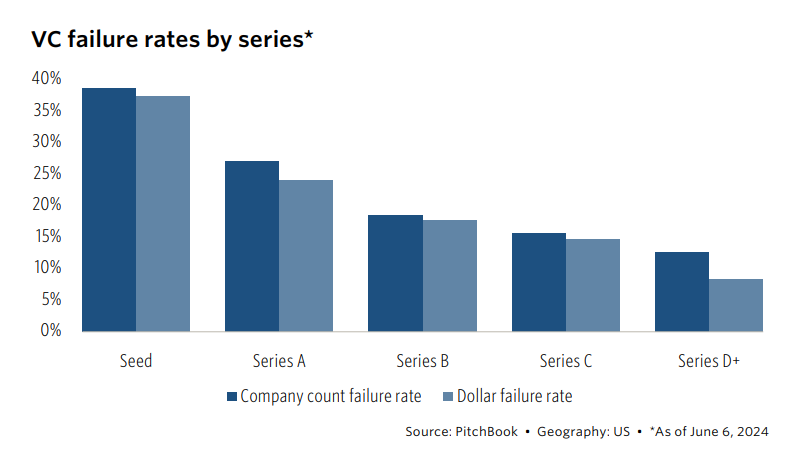
Investments often don’t increase in value. Quite often, they fail outright. Failure rate does reduce over time (39% at seed, 13% at series D), but it remains significant throughout.
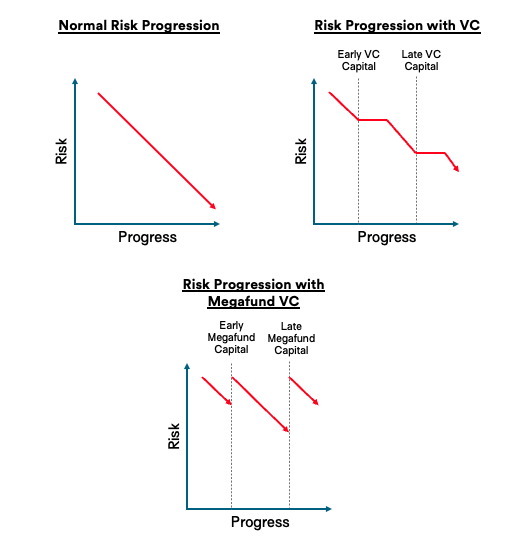
Typically, you think of a series A startup as less risky than a seed startup, and a series D startup as less risky than a series A startup. This is often true, but because VC dollars both add and remove risk, the move down the risk curve is less linear.
This is especially true for ‘the biggest winners’ who are often absorbing huge amounts of capital from the ‘venture banks’:
But in recent years, this picture has been skewed even more, especially if the capital raised comes from a mega VC fund. At each funding round, there is a significant re-risking of the startup, to the point that you are not moving meaningfully down the risk curve for a long long time. And even at a late stage, a mega funding round can bring you right back up to the point of maximum risk.
These rounds are also often highly dilutive; particularly with the proclivity of large firms to ignore pro-rata and cram-down early investors.
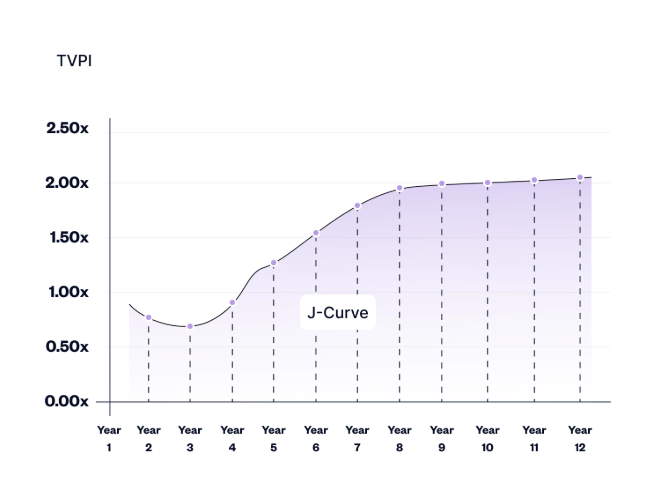
So, in an absolute sense, there is a sustained risk of failure which slowly concentrates portfolio returns into fewer companies over time, which will decelerate TVPI growth (or even turn it negative).
On top of that, there are often terms included in later rounds which mean that shares held by early investors become relatively overvalued. Particularly, IPO ratchet clauses and automatic conversion vetos. Thus, even if the theoretical TVPI of a seed fund remains flat, in reality it may be falling:
“In November 2015, Square went public at $9 per share with a pre-IPO value of $2.66 billion, substantially less than its $6 billion post–money valuation in October 2014. The Series E preferred shareholders were given $93 million worth of extra shares because of their IPO ratchet clause. This reinforces the idea that these shares were much more valuable than common shares and that Square was highly overvalued.”
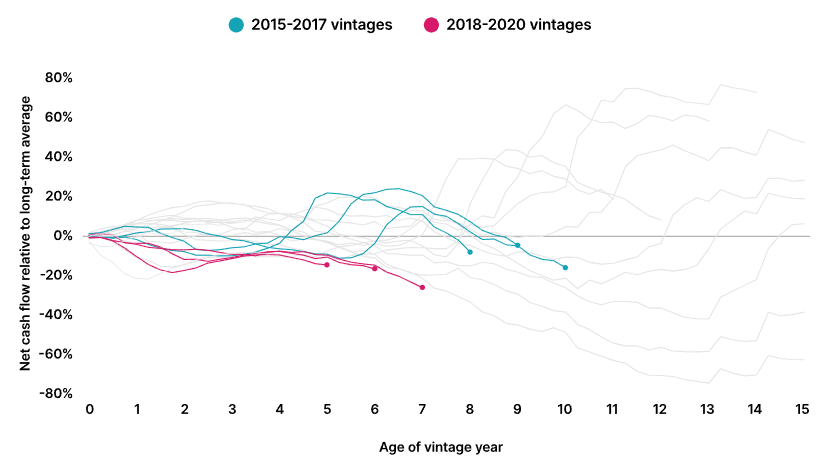
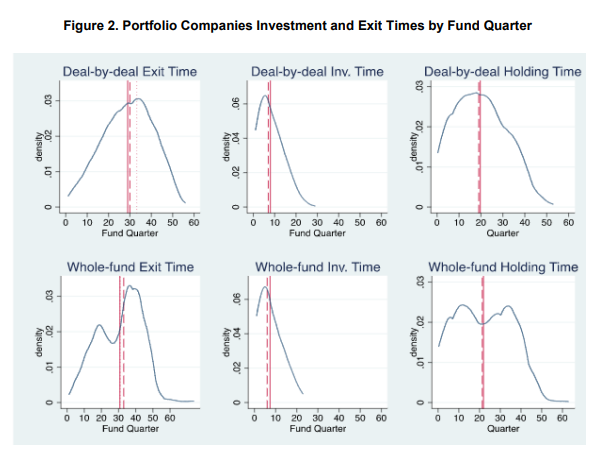
Looking at AngelList data, the best time for a fund to sell (on an IRR basis, and ignoring the clauses above) would be year 8 — with value concentrating (but not really net expanding) in years 9 through 12.
That means the typical investment (assuming a 3 year deployment period) would be best positioned for a (partial) sale in years 5-7. Considering this, it’s difficult to make the case that GPs should be holding 100% for the ultimate outcome, every time. If they do, they are concentrating their risk without necessarily improving the portfolio outcome.
To take this a step further, we could assume in a more rational market, less dominated by hype (more secondary activity driving more pricing tension, fewer bullshit markups), the illustrated TVPI would flatten out more gradually — so less of an obvious time to sell.
In short, the story here is not about opportunistic secondaries to drive better IRR. The real case to be made is for a comprehensive secondaries strategy, and opportunistic holding. For too long, there has been ideological friction around secondaries which has held back venture performance and enabled some very bad habits. It’s time to change that.
If there’s a chance to wipe the slate clean for venture capital, for LPs and GPs to return to first principles on compensation, incentives and ideal outcomes — to begin aligning venture capital with a high-performing meritocracy — it’s here, today.
Ironically, innovations in venture capital haven’t kept pace with the companies we serve. Our industry is still beholden to a rigid 10-year fund cycle pioneered in the 1970s. As chips shrank and software flew to the cloud, venture capital kept operating on the business equivalent of floppy disks. Once upon a time the 10-year fund cycle made sense. But the assumptions it’s based on no longer hold true, curtailing meaningful relationships prematurely and misaligning companies and their investment partners.